
The First Capital
Listen to the audio version
When survival defines your identity, you will only see opportunities through the labour lens.
The rewiring required is so deep and spiritual, because it’s not just about money, it’s about how survival silently shapes self-concept.
You grow up believing you must always work harder, hustle more, and add one more side gig. You cannot play games at the investor or ownership level because survival has welded your identity to labor.
When I heard Dangote casually mention that Mr. Eazi runs 17 different businesses, I was impressed. So I had to research his businesses. What stood out for me was that none of his roles in those businesses is labor-based.
He is not frying plantain in one, coding in another, and serving drinks in a third. His roles are capital roles. His capital works through systems, partnerships, and equity.
Contrast that with the way most of us enter the marketplace, without buffers, without elite families cushioning our first falls. We enter the game with only our skill, our time, and our energy. And survival demands we spend it all.
Learning a skill is good. But the type of skills advertised in the labour market is also a trap. It keeps you in survival. And survival has no margin. One illness, one broken contract, one platform shift, and the whole engine collapses because you were the only engine powering it.
I began here, too. I remember sitting with myself and asking a question few people ask: “If I continue like this, where does it lead?” The answer was sobering.
The survival road ends in exhaustion. You may earn more than average, but without leverage, you remain stuck in a loop that looks like growth on the outside but burns you out from the inside.
That was when I decided to build my First Capital.
The First Capital is not Otedola money. It’s not elite access or funding promises. It is the first resource, structure, or leverage you engineer for yourself that frees you from being the only machine of your income. It is the discipline of turning your skills into infrastructure.
To see it clearly, you have to understand The Capital Pyramid inside the labor and capital market:
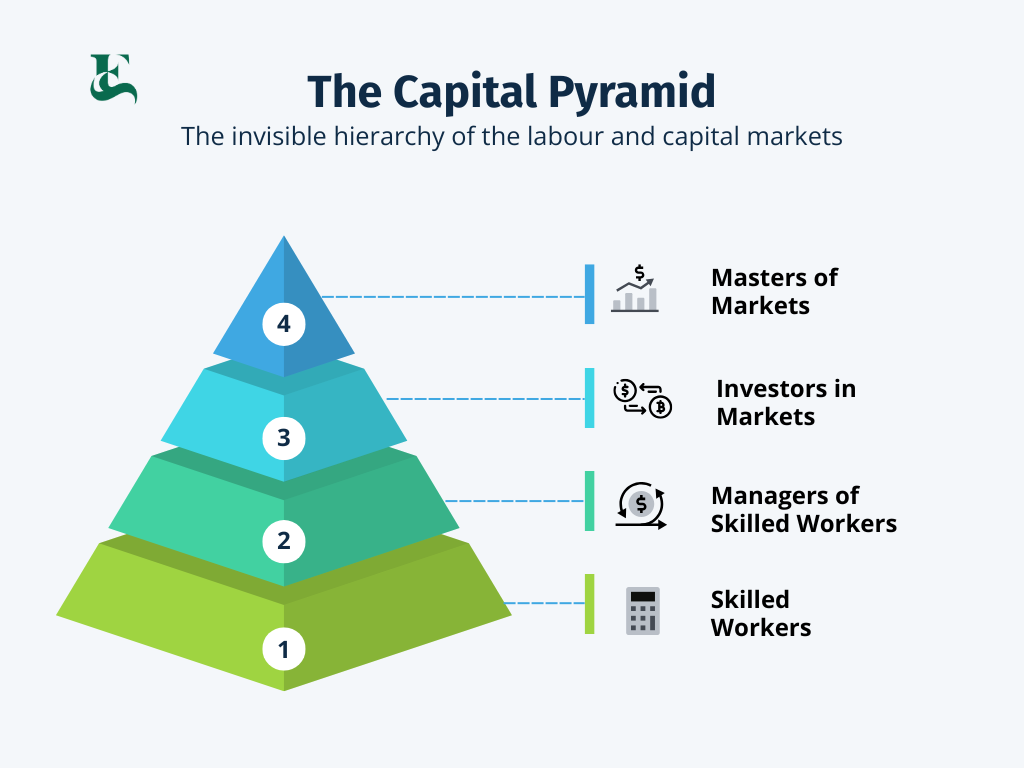
1. Skilled Worker: This is where most of us begin. You sell your skill, your time, your energy. You are the factory. Once you stop working, the income stops.
2. Manager of Skilled Workers: The first transition can happen in two ways:
In career, you rise into leadership. You’re no longer paid for just tasks but for outcomes you drive through other people. You move closer to executive roles and revenue-linked growth.
In business, you invest in machines that automate your processes and helps you sell at scale. You hire, starting with the most important roles, or even fractional team members. You begin the challenging but necessary work of building a team, managing processes, and moving beyond being a one-person survival machine.
3. Investor in Markets: At this stage, money begins to work for you. You invest in businesses, equity, or deploy capital in systems. Your expertise, networks, or strategy is now multiplied by capital.
4. Master of Markets: Very few people reach here. This is where you introduce a product, a platform, or a policy that shapes the market and world order. Your decisions ripples across the market and the world.
Your First Capital is built while you are still a skilled worker. Those years of sweat and skill are not to be wasted in low-income opportunities, they are the building blocks for your next. But if you never transition, you’ll remain locked in survival.
The Effects Of The Survival Identity
The survival identity limits your vision to the next hustle, the next client, the next gig. But survival has no margin. Inflation eats it. Bad governance shakes it. Even a family emergency can wipe it out.
Globally, the same pattern plays out. In America, the middle class has been shrinking because workers who stayed workers, even skilled, even educated, were wiped out by automation, outsourcing, or corporate restructuring. Those who transitioned into business owners, investors, or market-shapers thrived.
And the danger is not just economic; it is psychological. Survival rewires your brain to see only skill-level opportunities.
Even when you attempt to start a business, you only reproduce survival, self-employment with no systems, no processes, no leverage. You remain the only labour in your enterprise.
The chef doesn’t build a food brand, they just cook for more people.
The teacher doesn’t own an education company, they just tutor on Zoom after tutoring in class.
The engineer doesn’t build systems, they freelance 16 hours a day and call it independence.
So how do you make the transition? Let’s make it pragmatic:
The Pragmatic Pathways
For Career People:
Choose industries and job roles with strong economic growth, not just passion.
Get the qualifications, relationships, and positioning that tie you to revenue or core outcomes.
Optimize for compounding salaries, not just prestige.
Become an intrapreneur, someone who creates and drives new value within an organization.
For Business People:
Don’t just chase hype. Study the value chain of the industries you want to play in. Position yourself in industries with expansion potential.
Start small, but think scale from day one.
Hire, even fractionally. Begin learning the hard but necessary skills of team dynamics and leadership.
Build processes you can hand off. Without systems, you’ll never exit survival mode.
Master distribution, sales and revenue early. Leverage automation in your processes. These non-negotiable.
Listen to the market, not just your passion. Build what people actually pay for.
In simpler terms:
If you are a chef, stop being only the cook. Start being the one who builds the systems for growth while managing your cooks.
If you are a fashion designer, stop being only the hands behind the machine. Start being the one who ensures you hit your sales targets, or bring in a partner who ensures that.
If you are a freelancer or digital professional, stop being the only one who delivers projects. Start being the one who builds client relationships, partnerships, and revenue.
The Hard Truth
You will train and lose staff. Small businesses complain about bad hires like it's personal. Big corporations lose talent too. They poach from one another.
The difference is in the systems, buffers, and capital that help big corporations attract new talent and manage the loss of talent.
When leadership has only shown up in your life as exploitation, abuse, or dismissal, you will mistrust your own capacity to lead. But wealth is impossible without mastering leadership. You must master how to lead people to achieve a goal.
Back to your Identity
It all ties back to identity. Survival makes you identify only with labour roles.
Your first capital is the ladder that shifts you from playing survival games to capital games.
Remember, Identity Capital is both internal and external.
Internally, it’s your beliefs, your habits, your self-concept.
Externally, it’s your reputation, your network, your name in the marketplace.
You cannot scale if you remain the only labor of your enterprise.
Build your First Capital.
~ Culled from issue 13 of the Elevate Newsletter
Closing Thoughts
Thank you for trusting me with your attention.
I write the Elevate Newsletter every Tuesday at 11 a.m. (WAT), deep diving into life, work, and wealth to give you unique tools for decoding the world and building your own.
If you'd like to invite your network to read the Elevate Newsletter, please share this link.
https://www.eberelisa.com/letter
I often curate timely updates, valuable insights, and researched information on emerging opportunities, but we can’t fit everything into the newsletter.
For quick updates and real-time value, join our WhatsApp channel!
I'm rooting for you!
Ebere Lisa
SHARE


Get every letter!
Delivered to your inbox weekly.
About this blog
Elevated thought for decoding the world and building your own.


© 2025 Ebere Lisa